How Cities Can Better Leverage Bonus Density
Introduction
Bonus density is a part of a jurisdiction’s zoning ordinances that oftentimes play an important role in shaping a locality’s built environment. It allows a developer to produce more while returning more benefit to the public. It is a value exchange that can take the form of a planned unit development, overlay district, or inclusionary zoning ordinance. Bonus density works best when four scenario drivers are met, and there are specific instances in Washington, D.C. where bonus density has played a significant role. While some bonus density programs are acceptable, there are many ways to improve and enhance the outcomes of these projects.
What is bonus density?
In its simplest terms, bonus density allows a developer to build more in exchange for providing a public benefit. Depending on the jurisdiction and the specific bonus density zoning regulations, more development could mean additional lot coverage, a higher floor area ratio (FAR), a taller height limit, or an increase in the number of residential units allowed to be built. The public benefits typically include, but are not limited to, more affordable housing units, additional open green space, or better transit improvements.
How does bonus density work? In what ways is it used?
Bonus density can be thought of as a value exchange. A local jurisdiction would like to provide a public good, but is unwilling or unable to provide that public good on its own. A developer is looking to maximize the return of their investment by planning, designing, and building the maximum allowable project on a given site (i.e. the site’s highest and best use), but may be limited by the jurisdiction’s zoning regulations for that given site. To allow both parties, the jurisdiction and the developer, to get what they want, the jurisdiction will permit the developer to maximize their development on the given site in exchange for that developer providing a public good on or near that site. In most jurisdictions, including Washington, D.C., bonus density regulations are often administered through planned unit developments (PUD), overlay zoning districts, or the inclusionary zoning (IZ) process.
For bonus density to be granted using the PUD process, a negotiation between the developer and the city takes place solely for the conditions of the developer’s particular parcel. The additional bonus density granted, or not granted, to the developer are discretionary with oversight by the zoning commission. In contrast, bonus density using the overlay district or IZ process is a by-right development. This means a formula dictates the amount of additional density permitted for a developer based on the overlay district or IZ requirements.
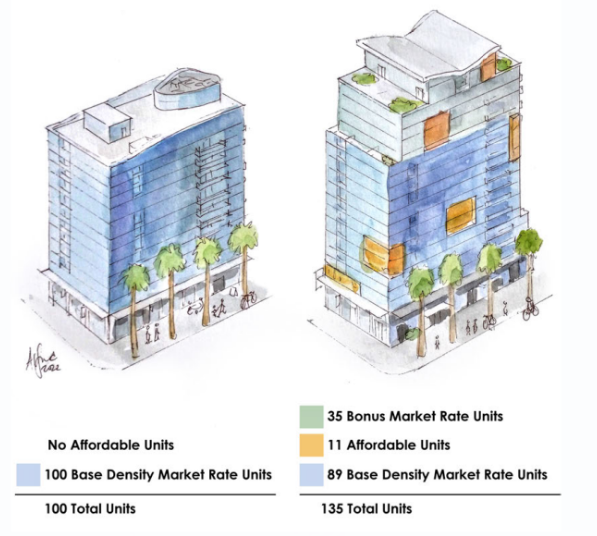
How San Diego envisions bonus density.
The illustration above was drawn by artist Alfred Twu and commissioned by Jesse O'Sullivan and Colin Parent, both policy counsels for Circulate San Diego, a commission established by the City of San Diego to study the impact of the city’s “Home Run for Homes” legislation. The legislation aimed to increase the production of market rate and deed-restricted affordable homes. The illustration provides an example of how the bonus density program works. Using no bonus density, the development on the left provided only 100 by-right market rate units on a given parcel. Using bonus density advantages on that same parcel, the image on the right shows how a developer could provide 135 total units by-right, with a mix of both market rate and affordable units.
When does bonus density work?
Bonus density works best when the following four scenarios are present.
First, like all real estate development projects, bonus density only works when there is market demand. If a parcel’s zoning regulations will allow for 100 units but the market will only support 75 units, there is no need for bonus density.
Second, once a market demand is determined, bonus density fares best in markets with high land values. Using our example of a parcel zoned for 100 units, if the market demands 125 units but the land is inexpensive, the developer would simply acquire an adjoining parcel and merge the two parcels to achieve the needed parcel size in order to develop 125 units. With high land values, a developer may be better suited to provide public benefits at a lower cost than acquiring an additional parcel.
Third, the costs of those public benefits must be clearly priced. For example, if a jurisdiction is requiring a developer to provide better accessibility and mobility to a nearby transit hub, a developer could quantify the cost of planning, designing, and constructing those accessibility and mobility accommodations and compare them to the costs of purchasing additional land. In areas with high land values, it is often less expensive to provide for the public good.
The fourth and final scenario needed for bonus density to work is a public administration capable of negotiating with and enforcing the points of a bonus density agreement. Without a strong local jurisdiction, density might be traded for low-value public goods or the negotiations might become politically polarized or the benefits might become arbitrary or vague.
Location and size of developments in Washington, D.C. that have implemented affordable housing units through the Inclusionary Zoning bonus density program since its inception in 2009.
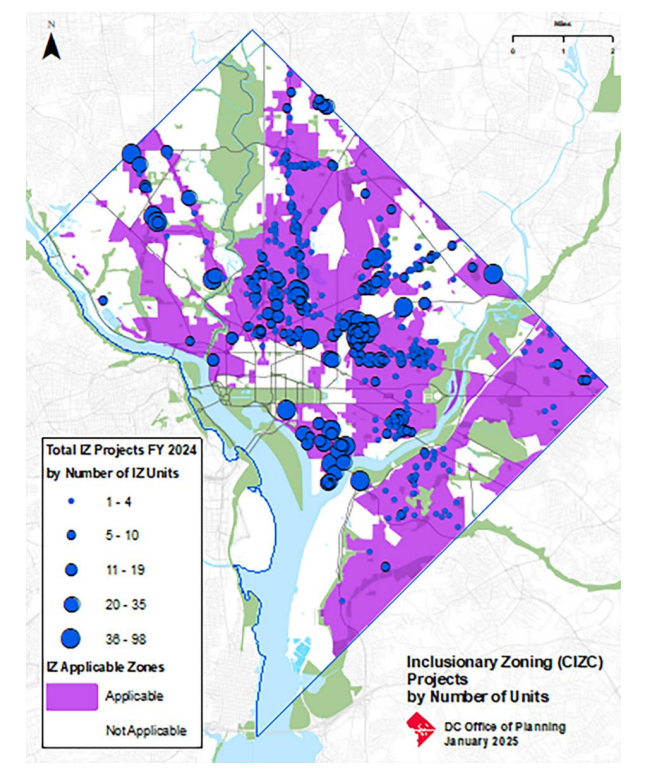
Location and size of developments in Washington, D.C. that have implemented affordable housing units through the Inclusionary Zoning bonus density program since its inception in 2009.
The map above, produced by the DC Office of Planning highlights the locations and quantities of projects that have implemented inclusionary zoning bonus density practices in the District of Columbia. What’s notable about the quantities and locations of these projects is that they align heavily with the first two scenarios required for bonus density to work best: high demand areas with high land values. In upper Northwest D.C. (often the most expensive area of the District), IZ projects are clustered around high-transit corridors like Wisconsin and Connecticut avenues. In Southeast D.C., IZ projects are clustered around the Wharf and Navy Yard, two expensive and highly amenitized neighborhoods. And in Northeast D.C., IZ projects are clustered around Union Station and the NoMa neighborhood, places with easy access to mass transit.
What are some examples of developments that have benefitted from bonus density?
Each year, the District’s Department of Housing and Community Development (DHCD) is required to publish a report outlining the impacts of the inclusionary zoning program in the District during the prior fiscal year. The latest report available, dated January 2025, highlights the success, or lack thereof, of the IZ program in fiscal year 2024. In FY2024, D.C. produced 144 total IZ-designated units through the approval of bonus density in 40 real estate development projects. In the 40 development projects that were approved for bonus density, the average amount of bonus density granted was approximately 17 percent of the base allowable density.
Comparatively, over 9,000 market rate units were planned in 2024, or approximately 1.5% of the total IZ units produced. While this many units were planned, approximately 1,800 units received construction permits, bringing the IZ percentage closer to eight percent of all units built. Since the inception of the IZ program in 2009, the District has produced 2,504 IZ-designated units.
DHCD highlighted a multifamily complex completed in FY2024 called The Margarite that utilized the PUD zoning process to create affordable housing units. Located in the NoMa neighborhood, a total of 260 units were constructed, of which 29 units were set aside as affordable units and the remaining 231 units were market rate. At this Union Market apartment complex, a market-rate one-bedroom unit (pictured below) starts at $2,175 per month.

The Margarite at Union Market.
Potential changes to bonus density programs
A simple question to ask about bonus density is whether or not it is necessary. If a jurisdiction is willing to provide more density to a developer, why not just offer that additional level of bonus density as the new maximum baseline density? Bonus density ordinances are not extra limits on what would otherwise be ordinarily allowed (a jurisdiction would simply reject the increased density outright if it didn’t want the additional density), but simply ways to extract resources from private developers for the public good. While there is nothing inherently wrong with this arrangement, a good question to ask is whether this vehicle of bonus density permissions is the best way to provide for those public goods.
The answer to that question would depend on what public good the jurisdiction is looking to provide. If the public good is affordable housing, would offering rental rebates to tenants for market rate apartments that are already developable by-right be a better substitute than having to navigate the IZ requirements? Perhaps funding zero interest loans for down payments for first-time homebuyers may be a better solution than developing IZ multifamily units. A recommendation to make bonus density more effective is to provide more structure around the negotiations between the developer and the jurisdiction, especially when it comes to planned unit developments.
Inclusionary zoning, while not free from its own set of drawbacks, is more predictable for a developer due to its use of formulas to determine the amount of increased density.
Perhaps a jurisdiction can produce its wish list of desired projects, price the costs of those public goods, and then through the PUD negotiation process, request the developers fund a certain percentage of items on the wish list based on the size or scope of the project.
Summary
An important tool for a planner is the use of bonus density programs, whether that be in the form of planned unit developments, overlay districts, or inclusionary zoning ordinances. In all programs, a private developer is asked to provide some benefit for the public good in exchange for increased density. Bonus density does not work in all scenarios, but it is a useful tool when four specific drivers are met. Finally, the bonus density programs can become more efficient when a jurisdiction clearly defines the needs of the public and the ways in which the private market can provide for those needs.