Recently, the U.S. House of Representatives passed the Housing in the 21st Century Act. This is the House's version of the Senate's ROAD to Housing Act passed in October. Together, these bills represent the most significant bipartisan movement in housing policy in over a decade. Next, the two chambers will appoint a Conference Committee to reconcile the bills and send to the President's desk for signature into law.
One of the most innovative elements of these bills is the concept of Pattern Zoning.
Pattern Zoning allows for the production of more housing in less time for less money built by a more diverse list of suppliers through the use of pre-approved designs in by-right zones. In this paper, I will break down each of those elements to show how Pattern Zoning could emerge as the next wave of zoning reform.
Introduction
In response to the limitations and deficiencies of traditional Euclidean zoning, Pattern Zoning serves as an innovative strategy for reforming land development rules in the United States for the benefit of local jurisdictions, real estate developers, general contractors, and potential home buyers.First, I'll provide an introduction of Pattern Zoning through a discovery of the history of Form-Based Codes, the original disruptor to traditional Euclidean zoning policies. Then, I'll dive into some of the shortcomings of Form-Based Codes that provide an opportunity for Pattern Zoning to emerge as the next innovator. From there, I'll analyze the innovation elements and attributes of Pattern Zoning. Finally, I'll provide some recommendations for paths forward to allow Pattern Zoning to cross the chasm into wider adoption across the country.
Form-Based Codes: The First Disrupter
To understand Pattern Zoning, a review of Form-Based Codes (FBCs) is necessary. “FBCs put more emphasis on built-form characteristics and less on land use to meet important design and development goals that are not easily achieved or are prohibited by traditional zoning approaches.” [1]
Traditional zoning approaches, referred to as Euclidean zoning, strictly separate different land use types. Since their enshrinement into law in the 1920s, single-family residential homes would not be placed in the same geographic area as light industrial uses nor would retail districts be placed in the same geographic area as professional office parks. While the separation of land uses is a hallmark in traditional zoning approaches,“FBCs are designed to facilitate compact development and mixed uses, encourage mixed-income communities, and generally make cities more sustainable.” [2]
The creation of Form-Based Codes stems from the birth of the New Urbanism design and planning movement. “New Urbanism’s principles and urban design manifesto coalesced in 1993 in the Charter of the Congress for the New Urbanism (CNU), which convened a network of likeminded architects, urban designers, planners, developers, lawyers, public officials, and citizen activists.” [3]
Proponents of New Urbanism abhor Euclidean zoning. They believe segregated land uses often lead to a loss of the sense of community. Instead, New Urbanists and supporters of FBCs believe great communities and neighborhoods should be “diverse, pedestrian-friendly… with mixed-land use destinations accessible within a five or ten minute walk.” [4]
One of the earliest examples of a community deliberately instituting Form-Based Codes is from Seaside, Florida in the 1980s. Designed by DPZ CoDesign, an urban planning and architectural firm led by Andres Duany and Elizabeth Plater-Zyberk, and developed by Robert Davis, a founding board member of CNU, Seaside was founded on nine guiding principles: walkability, connectivity, mixed uses, quality architecture, traditional neighborhood structure, increased density, smart transportation, sustainability, and a quality of life.
These guiding principles addressed “the relationship between building facades and the public realm, the form and mass of buildings in relation to one another, and the scale and types of streets and blocks.” [5]
In practice, these Form-Based Codes allow Seaside to have housing, shops, offices, restaurants, and other land use types to be built within the same geographic locations so long as the architecture of their respective built environments is a cohesive unit that blends across uses and ties together with the public realm (i.e. sidewalks, streets, and parks.) Since the creation of Seaside, other jurisdictions have implemented FBCs in all or parts of their communities.
Challenges to Crossing the Chasm for Form-Based Codes
While some jurisdictions have implemented FBCs, the trend, statistically, is still in Geoffrey Moore’s Early Adopter’s phase. As of 2019 in the United States there are only 549 unique jurisdictions implementing some type of form-based codes. [6] These jurisdictions cover a population of 27,191,000, or about 8.3% of the American people. (There are 37,705 unique county, city, and township jurisdictions in the U.S., meaning FBCs are used in less than 2% of all jurisdictions nationwide.)Only two of the top 50 U.S. cities by population, Denver and Miami, have implemented FBCs jurisdiction-wide. Though FBCs only cover a small portion of the country’s population and jurisdictions, the trend has increased exponentially in the last decade. Over 90% of the implementation of form-based codes across the U.S. has been instituted since 2017. Figure 1 highlights this quickly rising trend.
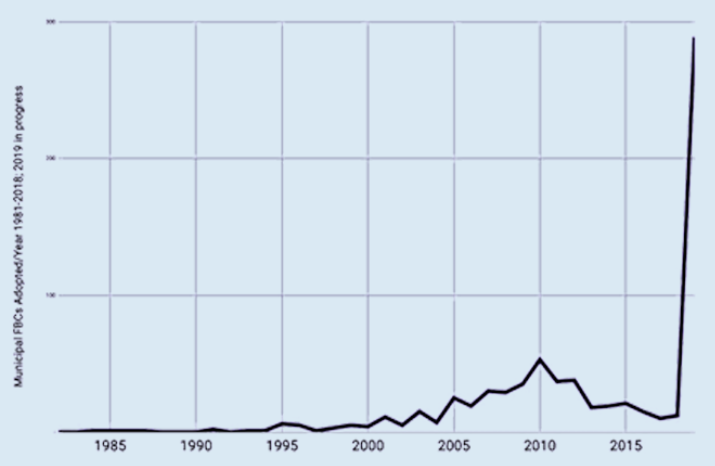
Figure 1. Adoption of Form-Based Codes (1980 - 2019.) Source: Hazel Borys, Emily Talen, and Matthew Lambert of PlaceMakers.
Even with the accelerating rate of adoption of FBCs, challenges to the ability for FBCs to “cross the chasm” still exist. (Over 5,400 more jurisdictions would need to adopt FBCs to simply be in the Early Majority phase.) According to Cornelius Nuworsoo, PhD, AICP, Professor of City and Regional Planning at Cal Poly San Luis Obispo and Evan Evangelopoulos, AICP, Associate Planner at the County of San Bernardino, six criticisms weigh heavily on the future growth of FBCs:
“Persistent form-based code criticism arises from beliefs that the codes are architecturally restrictive constraining the creative process of architects, disregard community, create indistinguishable towns with a uniform aesthetic forcing cities to accept the transect as a universal city theme, are of little help in towns lacking character, delay the entitlement process with strict regulations and unreasonable variances, incorporate incomprehensible jargon, and promote density and population increases to the detriment of locals.”
While those two authors agree that some of these criticisms can be explained away (i.e. any new zoning code usually requires community involvement prior to implementation), most criticisms have valid arguments and would need to be researched further to find effective solutions.
Pattern Zoning: Innovation Elements & Attributes
The challenges presented in the wider adoption of Form-Based Codes pave the way for an alternate disruption tactic to disentangle the traditional Euclidean zoning process, especially when it comes to providing more and more affordable housing. That potential alternative is Pattern Zoning. “At its core, a pattern zone is a technique for convenient-yet-contextual densification of existing urban landscapes.”[7]
FBCs are often best served in communities, neighborhoods, and enclaves that can afford (monetarily, socially, and logistically) to implement these enhancements to the public realms. From Clayton Christensen’s The Innovator’s Dilemma, PZ provides an opportunity for real estate developers to “attack from below.” PZ developers can build at a lower cost, using simpler methods, in a way that may be perceived as less respected to the dominant Euclidean zoning and FBC paradigms. Moreover, Pattern Zoning has the potential to disrupt and displace these paradigms over time by addressing underserved segments of homeowners, planning jurisdictions, and real estate developers.
Undoubtedly, Christensen would refer to Pattern Zoning as a disruptive innovation and not a sustaining one. David Morley, AICP, a research program and QA manager with the American Planning Association and editor of Zoning Practice describes Pattern Zoning as “rooted in three foundational concepts: pre-reviewed plans, the pattern book, and pattern zones.” The three innovations of Pattern Zoning aim to solve most of the challenges associated with FBCs crossing the chasm. In practice, Pattern Zoning allows a local jurisdiction to provide, either for a fee or free of charge, an aspiring real estate developer with a selection of various construction documents, typically architect- and engineer-stamped blueprints for residential properties, that have already been approved with full construction permits and land entitlements.
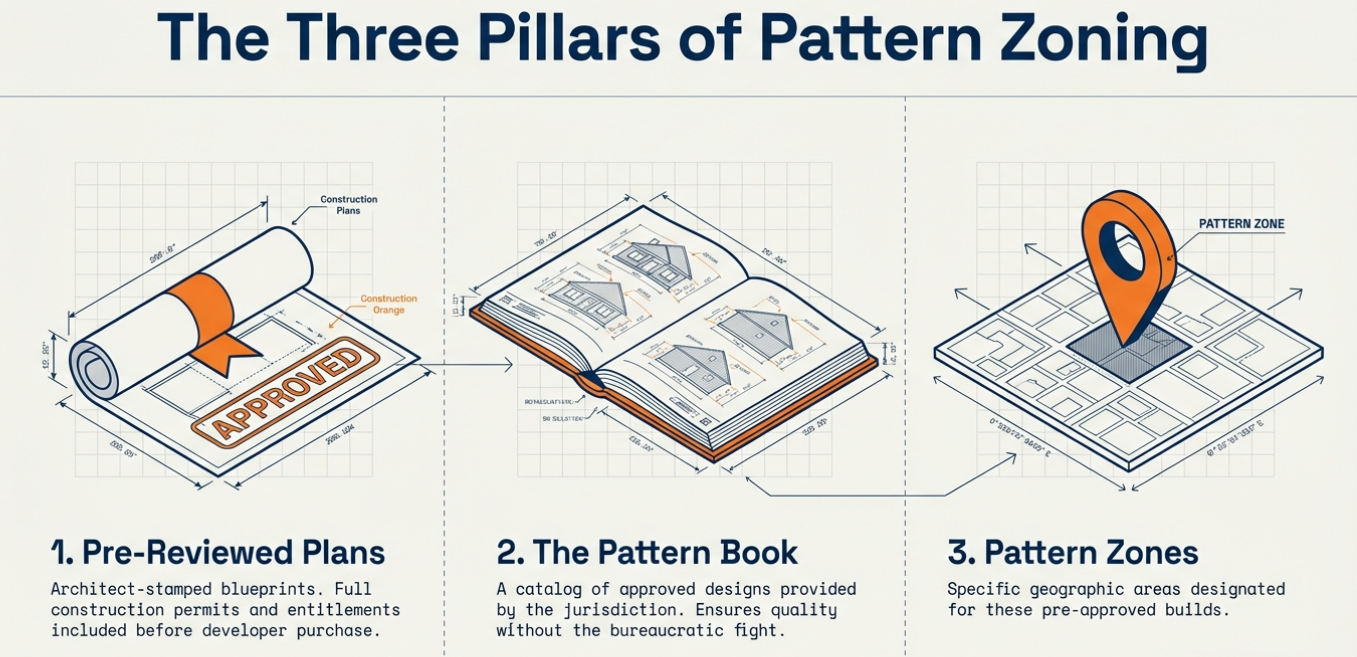
Graphic produced by NotebookLM based on my reporting.
The relative advantages of Pattern Zoning outweigh the benefits to both Euclidean zoning and Form-Based Code developments. In PZ developments, like FBC developments but unlike Euclidean zoning, beautiful, durable, and economic public realms are designed and built with care for the community’s character and they encourage density, mixed-use, and walkability. Crucially, PZ developments allow developers more choices in design through one of its three innovative elements: the reintroduction of catalog homes. Catalog homes, or kit homes, were popularized in the early 1900’s when companies like the Sears Roebuck & Co. would allow customers to purchase and receive all of the individual materials of a home from a mail-order catalog. The homeowner would then be responsible for erecting their home themselves.
“In an era where single-family housing was still relatively rare, mail-order homes were a way for middle-class families to attain a previously unaffordable goal of homeownership. In addition, Sears and some other manufacturers offered financing for the kits, and the applications didn't ask about race, gender, or ethnicity. This may have made it easier for immigrants, minorities, and single women to purchase homes… Sears estimated that a ‘man of average abilities’ could complete one of their houses in 90 days.”[8]
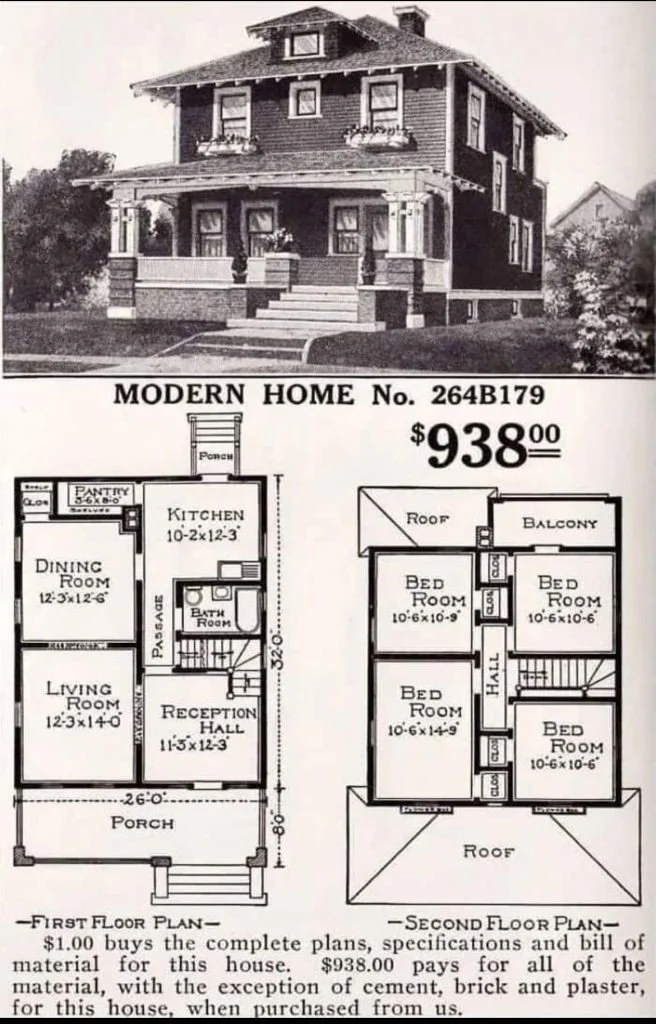
An excerpt from the Sears catalog in the early 1900's. Source: tinymodliving.com
While today’s PZ developments do not require homeowners to build homes themselves, they do allow homeowners to select from several pre-approved blueprints provided to the local jurisdiction by licensed architects. This selection process, along with input from a local jurisdiction and its constituents, offer architects more creative freedom than the more restrictive design covenants of Form-Based Codes. Furthermore, since the designs are pattern-based, the construction materials used in each development can be standardized.
This standardization could enhance the faster and greater adoption of sustainable building types or designs that allow for more accessibility options. Most importantly, standardized construction materials lead to overall cost reductions.
“The standardisation of layouts produces repeat and mirrored designs that, when used in the building process, provides continuity of production. This results in efficient material manufacture and the faster installation of components. As an example, developers and designers make use of modulation in residential construction by including repeat designs with regular shapes to allow buildings to be constructed more quickly compared with buildings that have a number of designs and/or irregular shapes. Where modulation is used, the fixed-price component of a single repeated item becomes less significant due to the quantity involved. For example, the design of a kitchen layout for 20 identical kitchens requires a draftsperson to produce one design, and because the design is payable just once the charge is insignificant when considering the cost to manufacture 20 kitchens.”[9]
Pattern Zoning’s two other innovations, pre-approved land entitlements and pre-approved building permits, address Everett Roger’s compatibility and complexity elements by offering a high degree of compatibility with existing codes and offering low barriers to entry for any future real estate developer. Pattern Zoning sits on top of and not in lieu of existing land use and building codes. Should a developer choose to use the existing Euclidean zoning prescriptions and conventional routes for entitling and permitting, they are still allowed to do so. (In communities with FBCs, the form-based codes are meant to take the place of traditional Euclidean zoning practices.) However, should a developer want (potentially) free design with an expedited permit, they would only need to select from a catalog of approved pattern zoning options.
As for addressing the complexity of entitling and permitting a real estate development, PZ takes the guesswork and uncertainty out of the bureaucratic processes while also lowering the cost of the development. In an ideal world,
“development occurs through the interaction between the interests of public and private actors. A developer must be able to acquire and sufficiently achieve site control at a reasonable timeframe and cost to move forward with the planning for design and construction. Public policy (which includes zoning, and guides land use, density and design) must strike a balance between responding to community needs and still allowing the developer to realize economically viable projects.”[10]
Across the globe, studies show how the often cumbersome bureaucratic process of obtaining a development approval can add time and cost to a project. “The Greater Toronto and Greater Vancouver Areas have the longest approval times in Canada, which are almost 4 times as long as regions with more affordable housing.”[11]
In New South Wales, Australia, where pattern zoning was partially implemented, government officials say it reduced the cost of development between 5% and 17%. Furthermore, with a less cumbersome, faster, and less expensive approval process, PZ developments allow for a more diverse mix of developers to construct more housing.[12]
In South Bend, Indiana, many developers are “women and people of color, and most did not come from wealth or connections. Most of them operate in the city’s historically poor and redlined neighborhoods, and came to be developers out of a love of the community and a deep desire to see it recapture its past vitality. They are supported by not just a ton of entrepreneurial and activist energy, but also by champions within City Hall.”[13]
The Beachhead: Rebounding Rust Belt Cities
To expand the wider adoption of Pattern Zoning, a beachhead is needed. Using Geoffrey Moore’s Crossing the Chasm metaphor, a beachhead strategy allows a PZ developer to “target a very specific niche market where you can dominate from the outset, drive your competitors out of that market niche, and then use it as a base for broader operations.”The beachhead best suited for Pattern Zoning is likely found in small to mid-sized Rust Belt cities. These communities struggle with housing demand, regulatory fatigue, and limited architectural and jurisdictional capacity. They also have a “prevalence” of abandoned lots, perfect for infill development that is well suited to Pattern Zoning. They are often overlooked by traditional zoning reform efforts but stand to benefit the most from pre-approved, design-forward building templates. Already, South Bend, Indiana is leading the charge. A clear win there could serve as proof for broader adoption.
Recommendations for Sustaining Innovations to Pattern Zoning
As with any innovation, the opportunity for reinvention or further disruption should be expected, accepted, and encouraged. To provide for further sustaining innovations to Pattern Zoning, urban planning practitioners should have more training and licensure requirements in design and construction; federal laws, and not just local or state laws, should provide guidance and acceptance of PZ development; and artificial intelligence (AI) should be utilized to further streamline the design, entitlement, and permitting process.
Kaizer Rangwala, AICP, CEcD, CNU-A a member of the board of directors of the Form-Based Codes Institute, encourages planners to gain more knowledge and experience in the physical design fields of architecture, engineering, and construction. “Planners should reclaim their heritage in physical planning and design and lead this effort… Planning organizations and universities should offer urban design as a core course and the planner’s certification exam should test for competency with physical planning.”
In July 2025, U.S. Senators Lisa Blunt Rochester (D-Del.) and Bernie Moreno (R-Ohio) introduced the Accelerating Home Building Act. The Act would “establish a pilot HUD-administered grant program to fund the creation of pattern books with a focus on missing middle and infill construction and provide set-asides for rural communities and prioritize high-opportunity areas and localities working to reduce barriers to housing development.” The Act acknowledges that “land-use regulations, permitting processes, and other regulatory burdens hinder housing production and drive housing costs up.” Furthermore, the Act has support from prominent industry trade groups including the American Planning Association (APA), the CNU, Smart Growth America, Main Street America, the National Association of REALTORS, and the National Urban League. Every effort should be made to ensure the pilot program is well-funded, well-organized, and capable of producing high-quality results that can be copied across every jurisdiction in the country.
Finally, PZ proponents should explore uses of artificial intelligence into the pattern zoning process. Sandeep Ahuja, cofounder of Cove, an AI-native architecture firm, described a common pain point during the design process for a multifamily project: “junior architects still [had to] redraw trash chute details from scratch—something we’ve solved hundreds of times. We should automate those inefficiencies.” While Cove may be considered an Innovator by Geoffrey Moore’s standards, the vast majority of architectural firms have yet to utilize AI tools in the design process. According to the American Institute of Architects (AIA), “only 6% of the profession regularly use AI for their jobs. Overall, only 8% of firms have implemented AI solutions into their practice, with a further 20% currently working on implementing solutions. This is driven significantly more by large firms (50+ employees), the early adopters in this space.” Notably, the AIA is not a trade group in support of the Accelerating Home Building Act.
Summary
Pattern Zoning emerges as a compelling innovation in the evolution of land use regulation, offering responses to the limitations of both Euclidean zoning and Form-Based Codes. While FBCs have improved the built environment by encouraging walkable, mixed-use communities, their complexity, cost, and perceived rigidity have slowed broader adoption. By leveraging pre-entitled and pre-permitted designs, Pattern Zoning reduces the time, cost, and uncertainty typically associated with the development process. Moreover, PZ projects reflect many of the favorable innovation attributes described by Everett Rogers and Clayton Christensen, positioning it well to “attack from below” and gradually displace the more entrenched zoning frameworks.Looking forward, Pattern Zoning has the opportunity to expand its impact through strategic reinvention. This includes integrating AI technologies to further automate design and permitting tasks, aligning federal policy with local implementation, and equipping urban planners with deeper training in design and construction. If supported by effective governance and professional adaptation, Pattern Zoning can move from an emergent tool to a standard planning practice.
Article References
[1,2] Garde, Ajay, Cecilia Kim, and Oscar Tsai. “Differences Between Miami’s Form-Based Code and Traditional Zoning Code in Integrating Planning Principles.” Journal of the American Planning Association 81, no. 1 (2015): 46–66. https://doi.org/10.1080/01944363.2015.1043137.
[3,4] Ivonne Audirac. “Old vs. new urbanism.” In T. Banerjee & A.Loukaitou-Sideris (Eds.), Companion to urban design (pp. 510), New York, NY, Routledge. (2011).
[5] Seaside Institute. “New Urbanism Principles.” Accessed July 18, 2025. https://seasideinstitute.org/new-urbanism-principles/.
[6] PlaceMakers. “The Codes Study.” Accessed July 20, 2025. https://placemakers.com/codes-study/.
[7] Steuteville, Robert. “’Pattern zone’ Enables Quality Infill Development.” Public Square: A CNU Journal, May 12, 2020. Accessed July 20, 2025. https://www.cnu.org/publicsquare/2020/05/12/pattern‑zone‑enables‑quality‑infill‑development.
[8] Federal Reserve Bank of Richmond. “Economic History.” Econ Focus (Second/Third Quarter 2019). Accessed July 26, 2025. https://www.richmondfed.org/publications/research/econ_focus/2019/q2-3/economic_history
[9] Towey, Donald. Cost Management of Construction Projects. John Wiley & Sons, Incorporated. 2013. ProQuest Ebook Central. http://ebookcentral.proquest.com/lib/georgetown/detail.action?docID=1211623. 60.
[10] Supply Attainability Full Report. Accessed July 26, 2025. https://static1.squarespace.com/static/59681b3646c3c4fa0a65b387/t/5ce43b1d5ea3580001b52dce/1558461243385/SupplyAttainability_FullReport.pdf.
[11] Canada Mortgage and Housing Corporation. “Approval Delays Linked with Lower Housing Affordability.” The Housing Observer, July 13, 2023. Accessed July 26, 2025. https://www.cmhc‑schl.gc.ca/observer/2023/approval‑delays‑linked‑lower‑housing‑affordability.
[12] Davies, Anne. “Architectural Home Designs for $1: NSW Releases Housing Pattern Book Aimed at Boosting Construction.” The Guardian Australia, July 15, 2025. Accessed July 16, 2025. https://www.theguardian.com/australia-news/2025/jul/16/architectural-home-designs-for-1-nsw‑releases‑housing‑pattern‑book‑aimed‑at‑boosting‑construction.
[13] Herriges, Daniel. “Pre‑Approved House Designs Jump‑Start Infill Development in South Bend.” Strong Towns Journal, October 6, 2022. Accessed July 28, 2025. https://www.strongtowns.org/journal/2022/10/6/pre-approved-house-designs-jump-start-infill-development-in-south-bend.