Most people think facades are about aesthetics. They think of glass towers, ornate masonry, sleek curtain walls, or the visual identity of a building placed onto a skyline. While not incorrect. that understanding is incomplete. Increasingly, facades are becoming operational systems that shape how buildings perform, how institutions spend money, how occupants experience space, and how organizations pursue sustainability goals over decades.
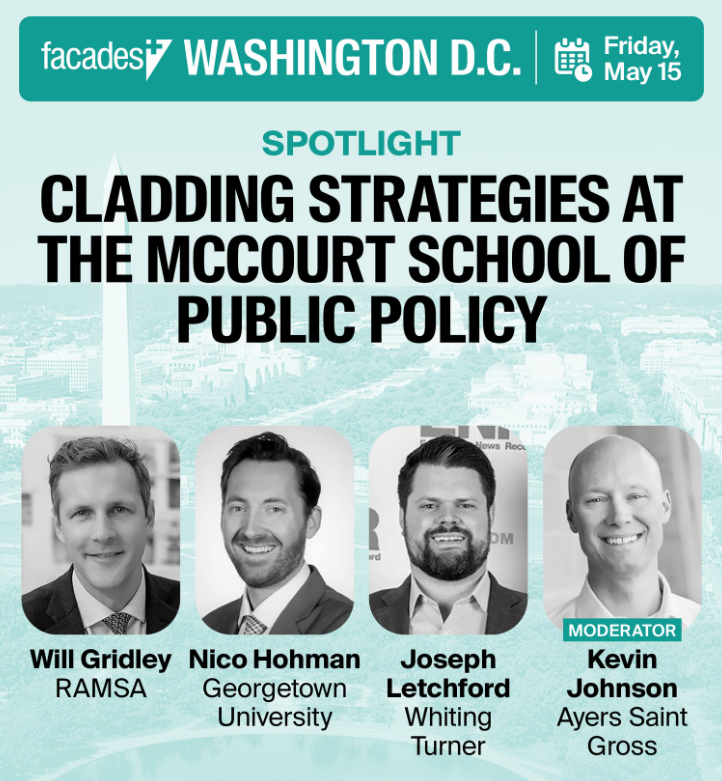
That shift was one of the clearest themes I took away from the recent Facades+ Conference hosted by The Architect's Newspaper team in Washington, D.C. (Hat tip Bernard Pollara, Gesunda Royal-Shipp, and to my co-presenters Will Gridley and Joe Letchford.)
Across presentations ranging from deep energy retrofits to mass timber wall systems, the consistent message was that building envelopes are the strategic infrastructure of a building’s operations.
Buildings are under growing pressure from every direction. Owners face tightening energy codes, carbon reduction targets, deferred maintenance backlogs, rising utility costs, climate resilience concerns, and increasing expectations around occupant wellness. At the same time, construction costs remain stubbornly high while institutions are expected to do more with less. The result is a built environment that can no longer afford to think about facades as decorative wrappers around buildings. They are becoming active systems that influence long-term institutional performance.
The opening presentation from Ayers Saint Gross reinforced this idea immediately. Stephen Wright and Kevin Johnson discussed how facade redesigns on campus buildings are influencing building functionality, operational efficiency, occupant comfort, and lifecycle performance. They mentioned how institutions increasingly evaluate buildings not just by what they look like on opening day, but by how they operate twenty or thirty years later.
In practice, I see this on a daily basis. Universities are effectively small cities with aging infrastructure, constrained budgets, political oversight, and ambitious sustainability targets. A poorly performing facade quickly becomes an operational liability when thermal inefficiency increases energy costs or water intrusion accelerates maintenance cycles. Even more so, poor daylighting impacts occupant experience while deferred envelope repairs eventually become capital crises.
In other words, the building facades are moving the edge of institutional strategy toward the center of construction and operational planning.
One of the most compelling sessions focused on deep green retrofits and the redesign of the American Institute of Architects global headquarters in Washington, D.C. The project team included Aida Wiebke, Felix Weber, and Karl Holden. The building itself presents a fascinating challenge. It is an exposed aggregate precast panel brutalist structure and also the first example of an all-glass curtain wall in the United States. That combination created both technical and political complexity. One speaker joked about the challenge of “designing a building for architects,” particularly when many architects no longer liked the building itself. So this project moved from not only being a sustainability retrofit but also a cultural statement. The project team had to involve competing philosophies about preservation, aesthetics, institutional identity, and environmental responsibility.
The AIA headquarters retrofit also reinforced another important point. Sustainable upgrades on historic structures are absolutely possible without sacrificing design quality. Too often, sustainability conversations become framed as either technological optimism or aesthetic sacrifice. High-performing retrofits require technical competence, financial discipline, and design restraint working together.
The presenters offered one particularly practical lesson that deserves broader attention. When pursuing ambitious redesigns on high-profile projects, keep the design review committee as small as possible. That advice may sound procedural, but it reflects an important reality about governance and decision-making in the built environment. Large committees often dilute accountability, slow momentum, and create design-by-compromise outcomes that satisfy nobody. Good projects require leadership willing to make decisions, absorb criticism, and maintain clarity of purpose. Many institutions today are attempting to modernize aging facilities while simultaneously reducing operational carbon and preserving historic identity. Those goals are often in tension with one another. But, disciplined decision-making is grounded in long-term priorities.
Sustainable Material Selection
The session on advances in building materials pushed this conversation further by focusing on the relationship between performance, sustainability, and material supply chains. Speakers included Allie Carlson, AIA, Frank McKnight, Raymond Shelton, and Brian White of HB Fuller.
They all emphasized that better buildings start with better materials. Better materials start with better ingredients and better manufacturing processes.
For years, sustainability discussions in the building industry focused heavily on operational efficiency. HVAC systems, electrification, smart controls, and renewable energy dominated the conversation. But the industry is increasingly recognizing that embodied carbon and material sourcing matter too. A highly efficient building constructed from carbon-intensive materials still carries a significant environmental footprint.
Aluminum became one of the central topics during the discussion. That is understandable given its enormous role in facade systems. Aluminum offers durability, corrosion resistance, flexibility, and long service life. In many ways, it is one of the defining materials of modern construction. Yet its production process is energy intensive, which creates difficult sustainability tradeoffs. The speakers acknowledged both its performance advantages and its environmental costs. They discussed how increased recycled content, improved energy consumption practices, and better sourcing strategies can significantly improve sustainability outcomes.
The question about which materials to use isn’t as simple as selecting a “good” or a “bad” material. The better question to ask is whether the material’s full lifecycle aligns with the long-term operational, environmental, and financial goals of the organization using it.
That shift toward lifecycle thinking represents a broader maturation within the industry. Owners increasingly care less about marketing slogans and more about measurable performance. They want buildings that last longer, consume less energy, reduce maintenance burdens, and remain adaptable over time. Those are operational questions as much as environmental ones.
Mass Timber
The session on complex wall systems with mass timber highlighted another important trend shaping the future of facade design. Mass timber often receives attention because of its sustainability potential, but the more interesting challenge is integration. Buildings are becoming increasingly hybridized systems where glass, aluminum, engineered timber, sealants, thermal barriers, and structural assemblies must work together with precision.
The discussion emphasized the importance of ensuring curtain wall systems properly connect to mass timber structures in ways that preserve performance, durability, and constructability. Sustainability is now about ensuring entire assemblies function cohesively over decades of use, exposure, movement, and maintenance cycles.
This is where the conversation around facades becomes particularly important for institutional leaders, planners, operators, and developers. The building envelope increasingly sits at the intersection of architecture, engineering, finance, operations, and climate strategy. Decisions made at the facade level now influence long-term asset value, resilience, occupant wellness, energy consumption, maintenance obligations, and institutional reputation. The owners and institutions that recognize this shift early will likely make better long-term decisions about capital investment, modernization, and portfolio strategy.
The future of buildings will be defined by the proper integration of materials, systems, operations, sustainability targets, occupant expectations, and institutional goals are all becoming more interconnected. Today, facades sit at the center of that convergence more than ever before. The organizations that understand this best will build better-performing institutions.